
CCBHC is Rural Health Transformation
18 months of data show how 4C Health is changing the way behavioral health care is accessed, delivered and experienced across rural communities
North Central, IN– Rural health transformation is more than adding services. It is about making care easier to access, building the workforce needed to provide it, keeping people connected to care, responding to needs in the community, and addressing the social factors that influence health.
For 4C Health, the Certified Community Behavioral Health Clinic (CCBHC) model has provided a framework for advancing that work.
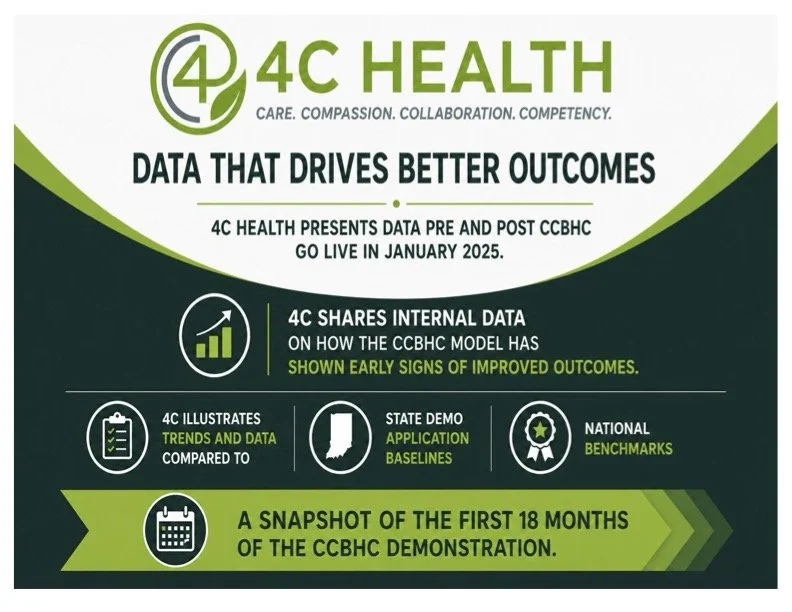
Eighteen months into the CCBHC demonstration, 4C Health is seeing measurable changes across access, engagement, workforce capacity, crisis response and social health outcomes. The organization is sharing its internal data to demonstrate what rural behavioral health transformation can look like when measurement is used to identify opportunities, guide action, and continually improve care.
Dr. Carrie Cadwell, President & CEO states, "The trajectory 4C Health is on and where we continue to head with the Certified Community Behavioral Health Clinic model affirms that it is the right investment, right model of care, at the right time, in the right rural areas, and in partnership with the right state. We must get even better at what we do and we will."
Transforming Access
One of the clearest areas of change has been access to services.
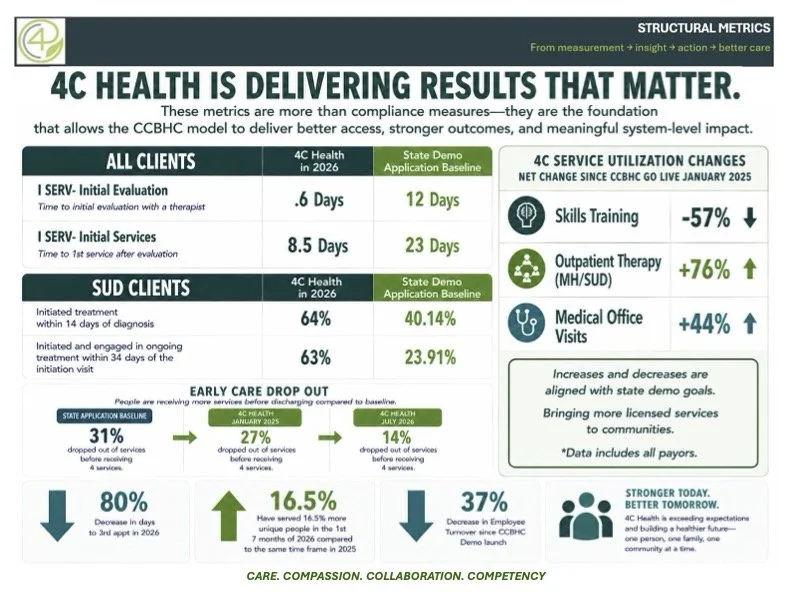
For all clients, 4C Health's average time from intake to an initial evaluation with a therapist decreased from 12 days at the state demonstration application baseline to 0.6 days in 2026. The average time from initial evaluation to a person's first service also declined from 23 days to 8.5 days.
Among individuals receiving substance use disorder services, 64% initiated treatment within 14 days of diagnosis, compared with a 40.14% state demonstration application baseline. Sixty-three percent initiated and engaged in ongoing treatment within 34 days of their initiation visit, compared with a 23.91% baseline.
The organization also saw an 80% decrease in days to a third appointment in 2026 and served 16.5% more unique individuals during the first seven months of 2026 compared with the same period in 2025.
These changes reflect a continued focus on reducing the distance—both physical and procedural—between a person asking for help and actually receiving care.
Transforming Engagement
Access is only the first step. Rural health transformation also requires keeping people connected to the care they need.
The percentage of people who dropped out of services before receiving four services declined from 31% in January 2025 to 14% in July 2026.
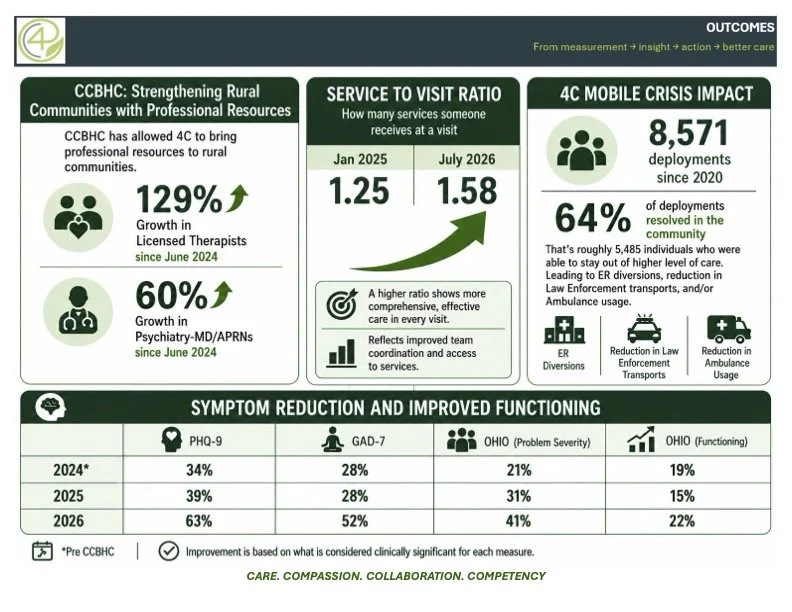
4C Health also saw its service-to-visit ratio increase from 1.25 in January 2025 to 1.58 in July 2026, meaning individuals are receiving more services during their visits as care teams work to address more of their needs.
Clinical measures are showing additional improvements. For example, the percentage of clients demonstrating clinically significant improvement increased between 2024 and 2026 on several measures, including:
Depression: 34% in 2024 → 63% in 2026
Anxiety: 28% → 52%
Youth Behavioral Health Problem Severity: 21% → 41%
2024 represents the pre-CCBHC period.
Transforming the Rural Workforce
Rural communities cannot transform access to care without transforming the workforce that provides it.
Since June 2024, 4C Health has experienced a 129% increase in licensed therapists and a 60% increase in psychiatry MD/APRN resources.
At the same time, employee turnover has decreased by 37% since the CCBHC demonstration launched.
For 4C Health, workforce development is directly connected to access. Building a broader mix of professionals and strengthening team-based care creates greater capacity to meet people where they are and connect them with the right level of support.
Transforming Crisis Response
Rural transformation also means rethinking where and how people receive care during a behavioral health crisis.
Since 2020, 4C Health's Mobile Crisis Team has completed 8,571 deployments, with approximately 64% resolved in the community. The organization's data indicate that community-based resolution has contributed to emergency department diversions and reductions in law enforcement transports and ambulance use.
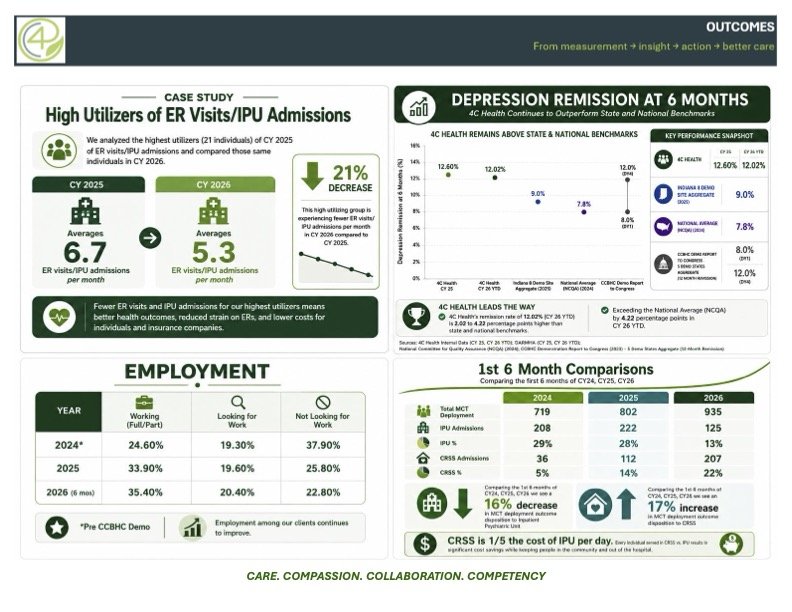
4C Health has also seen a shift in Mobile Crisis deployment outcomes, including a 16% decrease in dispositions to an inpatient psychiatric unit and a 17% increase in dispositions to Crisis Receiving Stabilization Services (CRSS) when comparing the first six months of 2024, 2025 and 2026.
These approaches allow more individuals to receive appropriate care while remaining connected to their communities.
Transforming Health Beyond the Clinic
Behavioral health does not exist separately from housing, food, employment, or financial stability.
As part of its CCBHC work, 4C Health is measuring social drivers of health to better understand the circumstances affecting the people it serves.
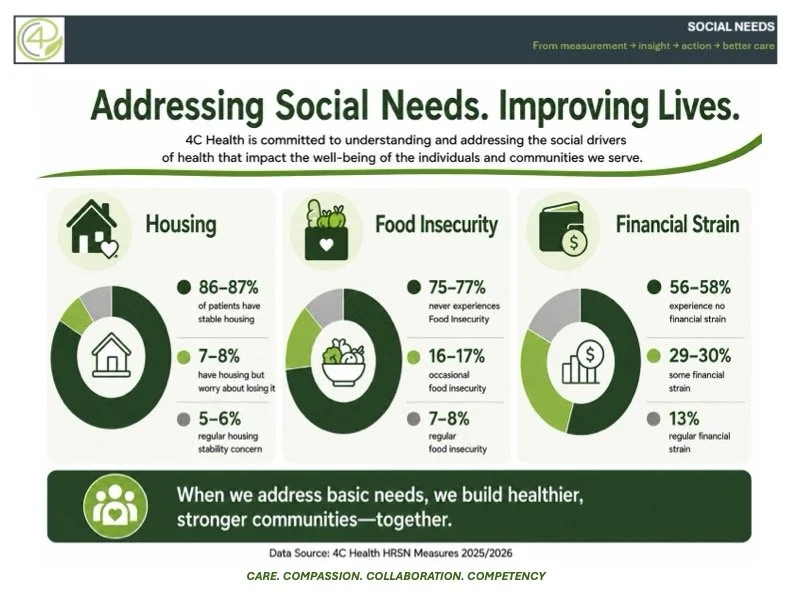
Current data show that 86–87% of patients report stable housing, 75–77% report never experiencing food insecurity, and 56–58% report experiencing no financial strain.
Employment among 4C Health clients has also increased, with the percentage reporting that they are working rising from 24.6% in 2024 to 35.4% during the first six months of 2026.
Understanding these factors gives care teams additional information about what may stand between an individual and long-term wellness.
Using Data to Drive What Comes Next
4C Health's 18-month data snapshot is not intended to suggest that every change is solely the result of the CCBHC model. Rather, it provides a look at how the organization has evolved during the demonstration period and how measurement, expanded resources and continuous improvement are shaping care.
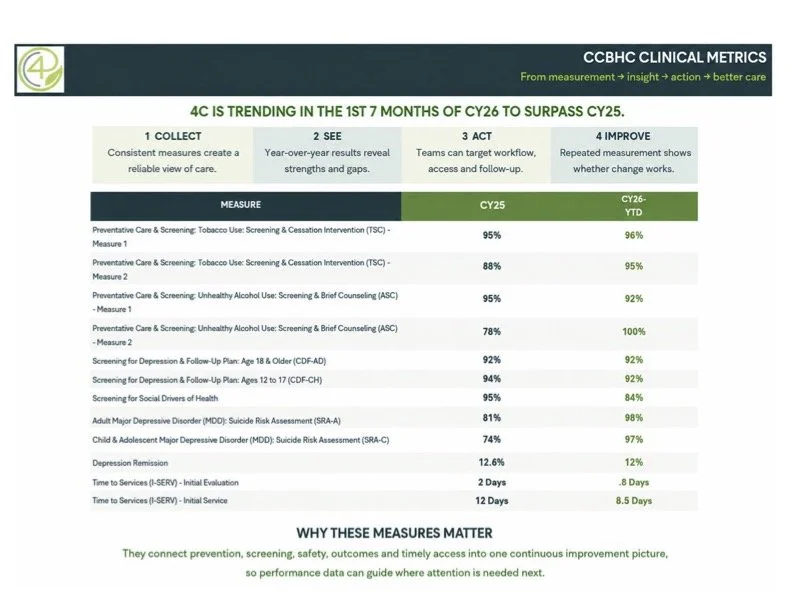
The data also show continued progress in clinical quality measures. During the first seven months of 2026, 4C Health's performance improved or remained strong across multiple CCBHC clinical measures, including tobacco screening, alcohol-use screening, suicide risk assessment, and time to services.
For 4C Health, the most important outcome is what the numbers represent: people getting connected to care sooner, staying engaged longer, receiving more comprehensive services, accessing care in their communities and having their broader needs recognized as part of their health.
About 4C Health
4C Health is a trusted non-profit Certified Community Mental Health Center and designated Certified Community Behavioral Health Clinic, serving North Central Indiana for over 50 years. With a focus on integrated behavioral and physical health, 4C Health provides a full continuum of care to individuals and families across Cass, Miami, Fulton, Pulaski, Howard, Tipton, and White counties.